This is something that I had been meaning to do for a while.
I even penned down some of my thoughts on how ABM made sense for understanding Wikipedia:
http://portal.acm.org/citation.cfm?id=1458550.1458565
Understanding the wikipedia phenomenon: a case for agent based modeling
Abstract:
"Wikipedia, the user led and monitored "open" encyclopedia has been an undoubted popular success. Of particular interest are the diffusion process of the innovation throughout the "contributor" community, and the question as to why unpaid, often well qualified, volunteers contribute content and time. Explanations for 'altruistic' contributor behavior based on the positivistic paradigm, and with roots in organizational psychology, while heavily researched and documented, have not been readily transferable to quantitative models of sufficient predictive value, in relation to Wikipedia's metrics. For despite the wide range of types, ages, locations and motivations of its contributors and seekers, investigators on Wikipedia have identified certain definite and often surprisingly universal trends ('laws') in its overall growth curve, organization structure, community and article formation. Models based on aggregated top-level relationships between entities on and around wikipedia suffer from assuming relationships between these entities as inputs to the wikipedia process, rather than emergent phenomena that evolve and change with the output. We argue for an Agent Based Model of Wikipedia, with the end objective of our work being a tool with diagnostic and/or prescriptive value for decision makers in organizations using or planning to use Knowledge Management Systems."
However, ultimately, I think it would still be difficult to make a clear case for the rationale, especially since ABM would only give me 2nd order predictions.
I've since then managed to bark up the right (hopefully!) tree. Have some interesting findings...
Will post lots more on that soon.
...deadlines are making a whooshing sound....
Showing posts with label wikipedia. Show all posts
Showing posts with label wikipedia. Show all posts
Wednesday, January 7, 2009

Thursday, May 15, 2008
Learning about the Social Networks behind Wiki
Two Layers of Network
(1) The articles network.
Every article in the Wikipedia contains references to other articles as well as external references. A set of links used for classification purposes is also available in most of the active articles of the encyclopedia. Every article represents a vertex in the article network and the internal connections between the article edges of the network.
(2) The contributors network.
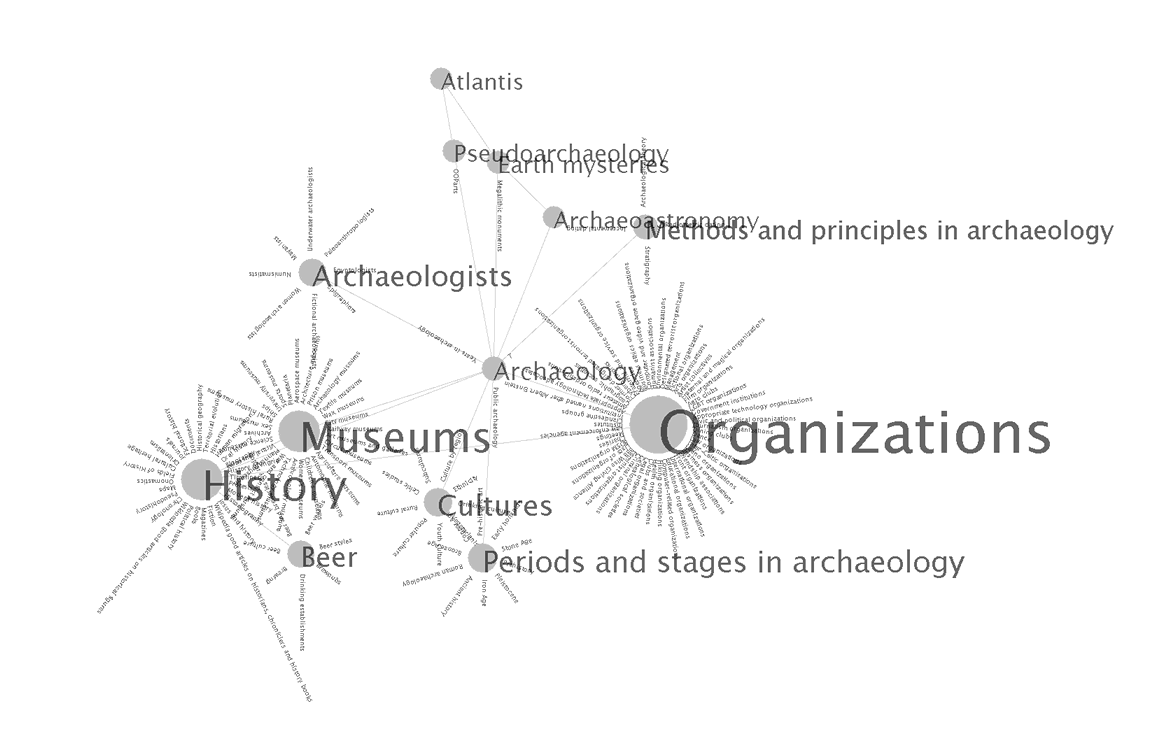
Wikipedia is a collaborative writing effort, which means that an article has multiple contributors. We assume that a contributor establishes a relationship with another contributor if they work on the same article. In the resultant signed network, a vertex represents each contributor, and their social ties (positive or negative) are represented by an edge denoting the sequence of their social interaction. Visualization of the Social Network of contributors behind the article "Immanuel Kant"
 Visualization of the Social Network of contributors behind the article "Immanuel Kant"
...And of course, I had already mentioned Chris Harrison's WikiViz Project. Talk about beautiful graphs!
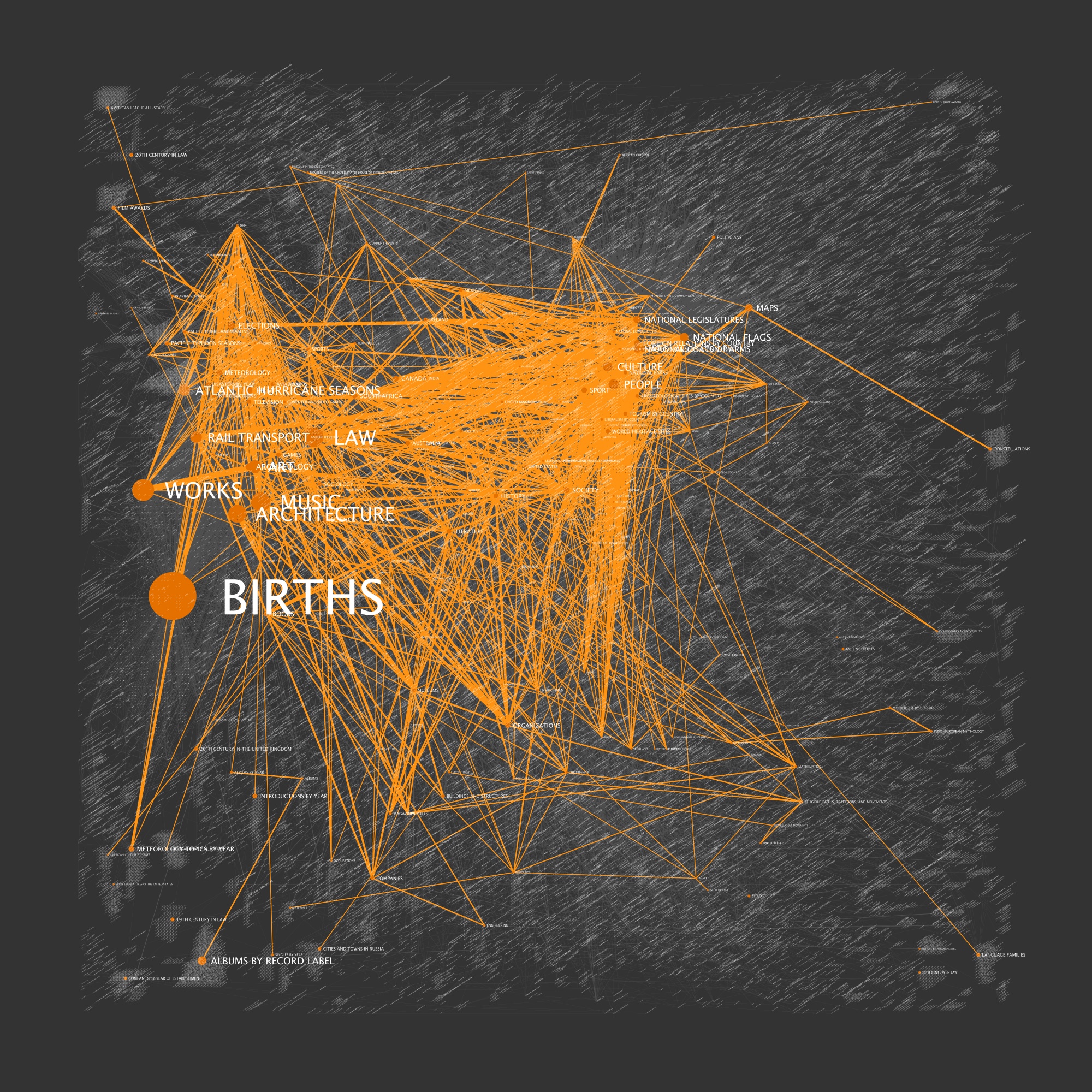
 You can also have a look at the Clusterball Project. Dont miss the movie.
10 Questions, with Jimmy Wales
This might be an oldish article, but just thought this might be a good time to dig this up.
http://www.time.com/time/business/article/0,8599,1601491,00.html
Jimmy Wales' answer to "Why do people contribute" is especially interesting
"...It's realizing that doing intellectual things socially is a lot of fun—it makes sense. We don't plan on paying people, either, to contribute. People don't ask, "Gosh, why are all these people playing basketball for fun? Some people get paid a lot of money to do that."
He also says "It turns out that people aren't as horrible as the Internet made them seem for a while."
http://www.time.com/time/business/article/0,8599,1601491,00.html
Jimmy Wales' answer to "Why do people contribute" is especially interesting
"...It's realizing that doing intellectual things socially is a lot of fun—it makes sense. We don't plan on paying people, either, to contribute. People don't ask, "Gosh, why are all these people playing basketball for fun? Some people get paid a lot of money to do that."
He also says "It turns out that people aren't as horrible as the Internet made them seem for a while."
All the Interesting Questions about Wikipedia on One Page
Just quickly, off the top of my mind, I can think of these
Growth
How fast will Wikipedia continue to grow in the near and far future?
Is there a limit to the growth (as per the logarithmic growth model)?
(...Or is "To know all is not permitted" !!?)
How will Quality of Content be affected in the near and far future, as Wikipedia grows?
Content
Is Wikipedia truly Reliable? Would you bet your life on a Fact from Wikipedia?
Can the regulatory mechanism be improved? How?
Do "Editing Wars" always lead to the "unbiased Truth"? (Can the Truth itself oscillate?!)
Does the process of "finding consensus" always lead to the best entry? (Is the "Average" always the right answer? Are there cases where the 'populist decision' may not be the 'right one' ?)
Motivation
What motivates Contributors? (The question "What motivates Seekers?" is fairly trivial)
What is the "carrot" at the end of the stick for contributors?
Will a contributor contribute content that has a high personal cost (or opportunity cost!) associated with sharing? (e.g: A stock trader chancing upon and then disclosing a piece of positive/negative news about a listed firm before it has broken on any other news channel, and without profiting personally, Or an inventor publishing on Wikipedia without thought of personal gain from his/her invention)
Culture
(I use the term very loosely here, as the "sum total of all human social knowledge".)
Can one uncover hidden cultural facets by studying the topography of the wikipedia network, by observing clusters, by deducing from "association" something of value? (somehow, again, I think - "Meme Theory"!)
What is the contribution of Wikipedia to Culture?
Growth
How fast will Wikipedia continue to grow in the near and far future?
Is there a limit to the growth (as per the logarithmic growth model)?
(...Or is "To know all is not permitted" !!?)
How will Quality of Content be affected in the near and far future, as Wikipedia grows?
Content
Is Wikipedia truly Reliable? Would you bet your life on a Fact from Wikipedia?
Can the regulatory mechanism be improved? How?
Do "Editing Wars" always lead to the "unbiased Truth"? (Can the Truth itself oscillate?!)
Does the process of "finding consensus" always lead to the best entry? (Is the "Average" always the right answer? Are there cases where the 'populist decision' may not be the 'right one' ?)
Motivation
What motivates Contributors? (The question "What motivates Seekers?" is fairly trivial)
What is the "carrot" at the end of the stick for contributors?
Will a contributor contribute content that has a high personal cost (or opportunity cost!) associated with sharing? (e.g: A stock trader chancing upon and then disclosing a piece of positive/negative news about a listed firm before it has broken on any other news channel, and without profiting personally, Or an inventor publishing on Wikipedia without thought of personal gain from his/her invention)
Culture
(I use the term very loosely here, as the "sum total of all human social knowledge".)
Can one uncover hidden cultural facets by studying the topography of the wikipedia network, by observing clusters, by deducing from "association" something of value? (somehow, again, I think - "Meme Theory"!)
What is the contribution of Wikipedia to Culture?
Wednesday, May 14, 2008
Computational Trust in Web Content Quality
Interesting points I found in Pierpaolo Dondio and Stephen Barrett, "Computational Trust in Web Content Quality: A Comparative Evalutation on the Wikipedia Project",
Informatica 31 (2007) 151–160
Abstract
The problem of identifying useful and trustworthy information on the World Wide Web is becoming increasingly acute as new tools such as wikis and blogs simplify and democratize publication. It is not hard to predict that in the future the direct reliance on this material will expand and the problem of evaluating the trustworthiness of this kind of content become crucial. The Wikipedia project represents the most successful and discussed example of such online resources. In this paper we present a method to predict Wikipedia articles trustworthiness based on computational trust techniques and a deep domain-specific analysis. Our assumption is that a deeper understanding of what in general defines high-standard and expertise in domains related to Wikipedia – i.e. content quality in a collaborative environment – mapped onto Wikipedia elements would lead to a complete set of mechanisms to sustain trust in Wikipedia context. We present a series of experiment. The first is a study-case over a specific category of articles; the second is an evaluation over 8 000 articles representing 65% of the overall
Wikipedia editing activity. We report encouraging results on the automated evaluation of Wikipedia content using our domain-specific expertise method. Finally, in order to appraise the value added by using domain-specific expertise, we compare our results with the ones obtained with a pre-processed cluster analysis, where complex expertise is mostly replaced by training and automatic classification of common features.
I thought interesting:
Ciolek, T., Today's WWW, Tomorrow's MMM: The specter of multi-media mediocrity, IEEE
COMPUTER, Vol 29(1) pp. 106-108, January 1996.
Predicted a seriously negative future for online content quality by describing the World
Wide Web (WWW) as “a nebulous, ever-changing multitude of computer sites that house continually changing chunks of multimedia information, the global sum of the uncoordinated activities of several hundreds of thousands of people”
.....On one hand, recent exceptional cases have brought to the attention the question of Wikipedia trustworthiness. In an article published on the 29th of November in USA Today , Seigenthaler, a former administrative assistant to Robert Kennedy, wrote about his anguish after learning about a false Wikipedia entry that listed him as having been briefly suspected of involvement in the assassinations of both John Kennedy and Robert Kennedy. The 78-year-old Seigenthaler got
Wikipedia founder Jimmy Wales to delete the defamatory information in October. Unfortunately, that was four months after the original posting. The news was further proof that Wikipedia has no accountability and no place in the world of serious information gathering .
How much do you trust wikipedia? (March 2006)
http://news.com.com/20091025_3-5984535.html
In December 2005, a detailed analysis carried out by the magazine Nature compared the accuracy of Wikipedia against the Encyclopaedia Britannica. Nature identified a set of 42
articles, covering a broad range of scientific disciplines, and sent them to relevant experts for peer review. The results are encouraging: the investigation suggests that Britannica’s advantage may not be great, at least when it comes to science entries. The difference in accuracy was
not particularly great: the average science entry in Wikipedia contained around four inaccuracies; Britannica, about three. Reviewers also found many factual errors, omissions or misleading statements: 162 and 123 in Wikipedia and Britannica respectively.
Gales, J. Encyclopaedias goes head a head, Nature Magazine, issue N. 438, 15, 2005
Trust
“trust is a subjective assessment of another’s influence in terms of the extent of one’s perceptions about the quality and significance of another’s impact over one’s outcomes in a given situation, such that one’s expectation of, openness to, and inclination toward such influence provide a sense of control over the potential outcomes of the situation.” - Romano
Computational trust was first defined by S. Marsh, as a new technique able to make agents less vulnerable in their behaviour in a computing world that appears to be malicious rather than cooperative, and thus to allow interaction and cooperation where previously there could be none.
Ziegler and Golbeck studied interesting correlation between similarity and trust among social network users: there is indication that similarity may be evidence of trust.
The most visited and edited articles reach an average editing rate of 50 modifications per day..."Speed" is one of the requirements that conventional techniques do not match up to.
In general, user past-experience with a Web site is only at 14th position among the criteria
used to assess the quality of a Web site with an incidence of 4.6% . We conclude that a mechanism to evaluate articles trustworthiness relying exclusively on their present state is required.
Alexander identified three basic requirements: objectivity, completeness and pluralism. The first requirement guarantees that the information is unbiased, the second assesses that the information should not be incomplete, the third stresses the importance of avoiding situations in which information is restricted to a particular viewpoint.
They claim to have proposed a transparent, noninvasive and automatic method to evaluate the
trustworthiness of Wikipedia articles. The method was able to estimate the trustworthiness of articles relying only on their present state, a characteristic needed in order to cope with the changing nature of Wikipedia.
Informatica 31 (2007) 151–160
Abstract
The problem of identifying useful and trustworthy information on the World Wide Web is becoming increasingly acute as new tools such as wikis and blogs simplify and democratize publication. It is not hard to predict that in the future the direct reliance on this material will expand and the problem of evaluating the trustworthiness of this kind of content become crucial. The Wikipedia project represents the most successful and discussed example of such online resources. In this paper we present a method to predict Wikipedia articles trustworthiness based on computational trust techniques and a deep domain-specific analysis. Our assumption is that a deeper understanding of what in general defines high-standard and expertise in domains related to Wikipedia – i.e. content quality in a collaborative environment – mapped onto Wikipedia elements would lead to a complete set of mechanisms to sustain trust in Wikipedia context. We present a series of experiment. The first is a study-case over a specific category of articles; the second is an evaluation over 8 000 articles representing 65% of the overall
Wikipedia editing activity. We report encouraging results on the automated evaluation of Wikipedia content using our domain-specific expertise method. Finally, in order to appraise the value added by using domain-specific expertise, we compare our results with the ones obtained with a pre-processed cluster analysis, where complex expertise is mostly replaced by training and automatic classification of common features.
I thought interesting:
Ciolek, T., Today's WWW, Tomorrow's MMM: The specter of multi-media mediocrity, IEEE
COMPUTER, Vol 29(1) pp. 106-108, January 1996.
Predicted a seriously negative future for online content quality by describing the World
Wide Web (WWW) as “a nebulous, ever-changing multitude of computer sites that house continually changing chunks of multimedia information, the global sum of the uncoordinated activities of several hundreds of thousands of people”
.....On one hand, recent exceptional cases have brought to the attention the question of Wikipedia trustworthiness. In an article published on the 29th of November in USA Today , Seigenthaler, a former administrative assistant to Robert Kennedy, wrote about his anguish after learning about a false Wikipedia entry that listed him as having been briefly suspected of involvement in the assassinations of both John Kennedy and Robert Kennedy. The 78-year-old Seigenthaler got
Wikipedia founder Jimmy Wales to delete the defamatory information in October. Unfortunately, that was four months after the original posting. The news was further proof that Wikipedia has no accountability and no place in the world of serious information gathering .
How much do you trust wikipedia? (March 2006)
http://news.com.com/20091025_3-5984535.html
In December 2005, a detailed analysis carried out by the magazine Nature compared the accuracy of Wikipedia against the Encyclopaedia Britannica. Nature identified a set of 42
articles, covering a broad range of scientific disciplines, and sent them to relevant experts for peer review. The results are encouraging: the investigation suggests that Britannica’s advantage may not be great, at least when it comes to science entries. The difference in accuracy was
not particularly great: the average science entry in Wikipedia contained around four inaccuracies; Britannica, about three. Reviewers also found many factual errors, omissions or misleading statements: 162 and 123 in Wikipedia and Britannica respectively.
Gales, J. Encyclopaedias goes head a head, Nature Magazine, issue N. 438, 15, 2005
Trust
“trust is a subjective assessment of another’s influence in terms of the extent of one’s perceptions about the quality and significance of another’s impact over one’s outcomes in a given situation, such that one’s expectation of, openness to, and inclination toward such influence provide a sense of control over the potential outcomes of the situation.” - Romano
Computational trust was first defined by S. Marsh, as a new technique able to make agents less vulnerable in their behaviour in a computing world that appears to be malicious rather than cooperative, and thus to allow interaction and cooperation where previously there could be none.
Ziegler and Golbeck studied interesting correlation between similarity and trust among social network users: there is indication that similarity may be evidence of trust.
The most visited and edited articles reach an average editing rate of 50 modifications per day..."Speed" is one of the requirements that conventional techniques do not match up to.
In general, user past-experience with a Web site is only at 14th position among the criteria
used to assess the quality of a Web site with an incidence of 4.6% . We conclude that a mechanism to evaluate articles trustworthiness relying exclusively on their present state is required.
Alexander identified three basic requirements: objectivity, completeness and pluralism. The first requirement guarantees that the information is unbiased, the second assesses that the information should not be incomplete, the third stresses the importance of avoiding situations in which information is restricted to a particular viewpoint.
 Modeling Wikipedia

They claim to have proposed a transparent, noninvasive and automatic method to evaluate the
trustworthiness of Wikipedia articles. The method was able to estimate the trustworthiness of articles relying only on their present state, a characteristic needed in order to cope with the changing nature of Wikipedia.
Is Wikipedia TrustWorthy?
Some people, especially academics, are uncomfortable with Wikipedia as a "source" of knowledge. Notwithstanding the regulatory and control mechanisms to prevent "vandalism" of content, there is still skeptism among most academics about how far Wikipedia can be a trustworthy resource.
In COMMUNICATIONS OF THE ACM September 2007/Vol. 50, No. 9, Neil L. Waters explains "Why You Can’t Cite Wikipedia in My Class"
A recent post on SlashDot quotes another IT professor saying:
"People are unwittingly trusting the information they find on Wikipedia, yet experience has shown it can be wrong, incomplete, biased, or misleading"
There was an interesting case recently of a "circular reference" created by Wikipedia. "Ali G", claimed a wikipedia entry, had worked for Goldman Sachs. No sources were given. This found its way into a popular mainstream media journal and Wikipedia became a reference to itself!
http://techdebug.com.nyud.net/blog/2008/04/19/wikipedia-article-creates-circular-references/
Where does that leave us?
I'll leave you with a quote from http://tech.slashdot.org/comments.pl?sid=521670&cid=23103370 (reference link above)
The real Wiki-vandals are the companies, governments and lobby groups of all sorts that flood Wikipedia with their squeaky clean corporate profiles (yes, corporate governments), whipped straight from their websites … These entities are the true threat to the laudable goal of Wikipedia to provide a freely accessible forum for the production and storage of (hopefully well-referenced) articles for the masses and a forum that does not restrict the privilege of contribution to those that have jumped through the all the right hoops. … The printed word is no more reliable than the plasma. Lies may be propagated on Wikipedia, but not without debate. Politicians spouting their sludge find their propaganda sitting side-by-side with those that mock them… If knowing that anything in a Wikipedia article is as likely to be crap as correct, the average reader becomes more vigilant in clicking through to the supporting sources; then Wikipedia has served the purpose of bringing to the masses the healthy skepticism that is, after all, the cornerstone of all academic pursuits.Dark eyes look down from ivory towers. Do they cheer or do they fear?
In COMMUNICATIONS OF THE ACM September 2007/Vol. 50, No. 9, Neil L. Waters explains "Why You Can’t Cite Wikipedia in My Class"
A recent post on SlashDot quotes another IT professor saying:
"People are unwittingly trusting the information they find on Wikipedia, yet experience has shown it can be wrong, incomplete, biased, or misleading"
There was an interesting case recently of a "circular reference" created by Wikipedia. "Ali G", claimed a wikipedia entry, had worked for Goldman Sachs. No sources were given. This found its way into a popular mainstream media journal and Wikipedia became a reference to itself!
http://techdebug.com.nyud.net/blog/2008/04/19/wikipedia-article-creates-circular-references/
Where does that leave us?
I'll leave you with a quote from http://tech.slashdot.org/comments.pl?sid=521670&cid=23103370 (reference link above)
The real Wiki-vandals are the companies, governments and lobby groups of all sorts that flood Wikipedia with their squeaky clean corporate profiles (yes, corporate governments), whipped straight from their websites … These entities are the true threat to the laudable goal of Wikipedia to provide a freely accessible forum for the production and storage of (hopefully well-referenced) articles for the masses and a forum that does not restrict the privilege of contribution to those that have jumped through the all the right hoops. … The printed word is no more reliable than the plasma. Lies may be propagated on Wikipedia, but not without debate. Politicians spouting their sludge find their propaganda sitting side-by-side with those that mock them… If knowing that anything in a Wikipedia article is as likely to be crap as correct, the average reader becomes more vigilant in clicking through to the supporting sources; then Wikipedia has served the purpose of bringing to the masses the healthy skepticism that is, after all, the cornerstone of all academic pursuits.Dark eyes look down from ivory towers. Do they cheer or do they fear?
Visualizing Wikipedia
Chris Harrison, over at the Human-Computer Interaction Institute at Carnegie Mellon University has some beautiful visualizations of Wikipedia's network structure. He calls this project WikiViz.
http://www.chrisharrison.net/projects/wikiviz/index.html
Apart from the stunning visuals, I am thankful to Chris for two ideas that came to me:
- Can Visualizations in the form of Graphs of Wikipedia be analyzed from the point of view of Meme Theory?
- Can I use GraphViz (or similar tools) to develop visualizations for concepts in Religious Texts?
Chris has, in another interesting project, undertaken a visualization of the social network present in the Bible (http://www.chrisharrison.net/projects/bibleviz/index.html).
Similar visualizations for the Gita and Quran should be possible. What would be the motive?
Some vague thoughts swimming in my mind at this stage- Memes, Clusters, Selective Pressures, Evolutionary theories of Culture.
http://www.chrisharrison.net/projects/wikiviz/index.html
Apart from the stunning visuals, I am thankful to Chris for two ideas that came to me:
- Can Visualizations in the form of Graphs of Wikipedia be analyzed from the point of view of Meme Theory?
- Can I use GraphViz (or similar tools) to develop visualizations for concepts in Religious Texts?
Chris has, in another interesting project, undertaken a visualization of the social network present in the Bible (http://www.chrisharrison.net/projects/bibleviz/index.html).
Similar visualizations for the Gita and Quran should be possible. What would be the motive?
Some vague thoughts swimming in my mind at this stage- Memes, Clusters, Selective Pressures, Evolutionary theories of Culture.
Modeling Wikipedia's Growth

 Wikipedia is one of the most interesting phenomena of current times.
One interesting area of study is the modeling of its growth.
If Wikipedia's growth follows the exponential growth model the average rate of growth would be proportional to the size of the Wikipedia. However, it appears that the rate of growth is slowing Maybe Wikipedia's growth follows the logistic growth model better. This model is based on:
- more content leads to more traffic, which in turn leads to more new content
- however, more content also leads to less potential content, and hence less new content
- the limit is the combined expertise of the possible participants.
Interestingly enough, while the number of articles may not be strictly following the exponential curve, we may consider that the quality of articles is, i.e if we assume that the number of edits per article is a measure of its quality.
 The graph is plotted in logarithmic scale, and this data also fits well with exponential growth starting from October 2002. The number of edits per article has since doubled once every 504 days.
Subscribe to:
Posts (Atom)